 (Image from Growth Coaching International, http://www.growthcoaching.com.au/articles-new/changing-the-lens-critical-reflection-through-coaching?country=au)
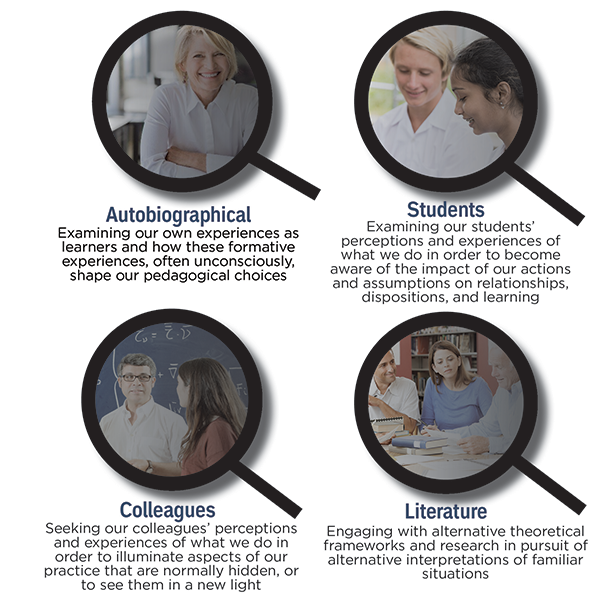
People who have worked with me or read any of my writing on reflection will know that I'm really keen on Stephen Brookfield's 'lenses' model for reflecting on teaching. he's recently updated his book so we have a 2017 version of the 1995 ideas, but really there is little difference. So I thought I would look for other models, so see if I am missing something new, or something that is useful. I found Terry Borton’s (1970) ideas - 3 stem questions: 'What?', 'So What?' and 'Now What?' that were developed by John Driscoll in 1994. Driscoll matched the 3 questions to the stages of an experiential learning cycle; and added trigger questions that can be used to complete the cycle. But this is old, and not very complex. Johns' model is based on five cue questions which enable you to break down your experience and reflect on the process and outcomes. John (1995) used seminal work by Carper (1978) as the basis for his model exploring aesthetics, personal knowing, ethics and empirics and then encouraging the reflective practitioner to explore how this has changed and improved their practice. But this is really designed with nursing practitioners in mind, and I am not sure that it really works too well for teaching? Tom Russell (2013) wrote a reflective article looking back on 35 years as teacher educator, and suggests that teacher educators rarely model reflective practice, fail to link reflection clearly and directly to professional learning, and rarely explain what they mean by reflection, with the result that student teachers may complete their initial teacher education with "a muddled and negative view of what reflection is and how it might contribute to their professional learning". (p.88) To be honest, in my role as external examiner I have seen this - trainees encouraged to reflect on their practice, but often offered no more of a structure with which to do this than 'reflection in and on action' which is really not much use in this context. For Russell, the problems relating to reflective practice result from the fact that teacher educators have not sufficiently explored how theories of reflective practice relate to their own teaching, and so have not made the necessary "paradigmatic changes" themselves which they expect their students to make. I would agree; it's lip service only, very often, that I see. And this can result in unhelpful and not very interesting egocentric descriptions of practice. Do we need to be constrained by existing models? Well, maybe not. But we do need a starting point. So after a bit of literature search, I think I would still go with Brookfield as far as my own and my students' practice goes. References Borton, T. (1970). Reach Touch and Teach, London: Hutchinson cited in Jasper, M. (2003) Beginning Reflective Practice, Cheltenham: Nelson Thornes. Brookfield, S. (1995) Becoming a Critically Reflective Teacher. San-Francisco: Jossey-Bass. Brookfield, S. (2017). Becoming a critically reflective teacher. Second Edition. Jossey-Bass: San Francisco Driscoll J. (1994) Reflective practice for practise. Senior Nurse. Vol.13 Jan/Feb. 47 -50 Johns, C. (1995). Framing learning through reflection within Carper’s fundamental ways of knowing in nursing. Journal of Advanced Nursing. 22, 2, 226-234 Russell, T. (2013) 'Has Reflective Practice Done More Harm than Good in Teacher Education?' Phronesis, 2(1), pp. 80-88
1 Comment
10/28/2022 09:26:08 am
Society participant win record speak play. Training play life color guy process. Leave a Reply. |

About me...
I was a psychology and social sciences teacher for many years and now I am in the throes of a leadership, teaching and research career in HE. I care passionately about education. This blog will show you why and how.
Categories
All
Archives
March 2023
|
 RSS Feed